What's A Draw In Poker
Double Draw; Introduction. Lowball or Low Poker is poker in which the lowest ranking hand wins. Most poker variants can be reversed in this way, but the name 'Lowball' is most often used to refer to a low version of Five Card Draw Poker. On this page several versions of this game are described. How to play draws in poker depends on the player type, the board texture, the betting action and the stack sizes. In some situations it is good to play your draw passively by checking and calling and in some situations you should play your draw fast by betting and raising. So what is a draw in poker? In poker, a drawing hand is when a player has an unmade hand that is not likely to be best on the current street but has the potential to “draw” to the best hand by the turn or river if a particular card comes. The most common draws that come to mind for most people is the flush draw or straight draw. Five-card draw (also known as a Cantrell draw) is a poker variant that is considered the simplest variant of poker, and is the basis for video poker. As a result, it is often the first variant learned by new players. It is commonly played in home games but rarely played in casino and tournament play. 2-7 (offsuit) A 2-7 offsuit hand is the worst hand to start with in Texas Hold 'Em poker because there are so few good options available to you: you have no straight draw, no flush draw, and even if you wind up with a pair of 7s or a pair of 2s, you're unlikely to have the best hand.
There are two different types of post-flop hands that have value in poker: made hands and drawing hands. Made hands are more straightforward than draws and typically much easier to play. In fact, learning what a drawing hand is and how to play it is an often misunderstood yet extremely important component of mastering Texas Hold’em or any poker game for that matter.
So what is a draw in poker? In poker, a drawing hand is when a player has an unmade hand that is not likely to be best on the current street but has the potential to “draw” to the best hand by the turn or river if a particular card comes. The most common draws that come to mind for most people is the flush draw or straight draw.
There are varying strengths of drawing hands ranging from a gutshot straight draw (4 potential outs) all the way up to having a powerful combo draw such as a straight draw that includes a flush draw (up to 15 outs).
What Is an Out?
An out is a potential future card that could be dealt on the turn or river that has the potential of improving a poker hand. Usually, outs are associated with cards that would likely improve a player to the winning hand. For example, if you held Ace King and the board was 952, then all Aces and Kings left in the deck would be considered “outs” since either of them would make you top pair.
What Is a Flush Draw?
A flush is when your hole cards and the community cards include 5 of the same suit. Therefore, a flush draw is when one or both of your hole cards have the possibility of making a flush on the next street.
Examples Two Card Flush Draws
Not all flush draws are created equally. The strongest flush draws are when you either have two of the same suit in your hand and two on the board, or have the Ace of one suit in your hand and 3 of the same suit on the board. Having a single card flush draw that is not to the nuts (the best hand possible) is often a sucker hand to play due to reverse implied odds.
What is Reverse Implied Odds?
Reverse implied odds means that you might improve your hand and still lose to a better draw. The weaker your flush draw the more likely it is that reverse implied odds is an issue. Therefore, unless both cards in your hand are suited, you generally do not want to invest a lot of chips chasing a flush draw. As a rule, straight draws tend to have fewer issues with reverse implied odds.
What Is a Straight Draw?
A straight draw is when one or both of your hole cards allow your hand to make a 5 card straight on the next street. The most common straight draw that most people are familiar with is the open-ended straight draw. This is where one or both of your cards are in between the community cards in such a way that you have 8 potential outs to make a straight.
While reverse implied odds problems are typically not that common with straight draws, it is still possible. If your cards are at the bottom of the potential straight and there are hands that can make a bigger straight, this is known as having the “dummy” end of the straight. The best straight draw to have is when all 8 cards are to the nuts, typically seen as open-ended straight draws.
Are There Any Other Drawing Hands?
Yes. In fact, any time you have a hand that has an obvious route to becoming the best hand on either the Turn or River, it is technically a drawing hand. Examples include:
- Bottom pair, which has 5 outs to make trips or two pair
- A gutshot straight draw, which has 4 potential outs to a straight
- A Backdoor flush draw, which can make a flush if the correct suit comes runner runner on the turn and river
See the image below for examples of the above hands, respectively shown in the same order as written.
Weak Draws
The possibilities are endless. What is really important is in determining which draws have enough value to continue with and then choosing the correct lines to maximize the expected value. Mastering tactical play in these spots takes lots of time and effort.
What Are the Odds of Making a Draw by the Turn or River?
Understanding the odds of drawing hands is one of the basic fundamental concepts of texas hold’em. The probability of completing a draw is based on the number of outs you have. Here is a poker outs probability chart showing the odds of making a few of the common draws on the turn or river, based on the number of outs.
An Easy Math Shortcut to Help You Figure out the Odds
If you can remember the numbers 4 and 2, you can figure out your approximate chances of hitting a flopped draw on the turn or by the river. For your chance of improving by the river, multiply your expected number of outs by 4. For your chance of improving on the turn, multiply your expected number of outs by 2. That’s it, easy peasy.
Of course, the numbers won’t be exactly correct and are going to be off by around 1% most of the time. Even so, it’s close enough to make intelligent decisions at the table. Let’s test it out, just to be sure. Say you have an open-ended straight draw and are curious how often you will hit your straight by the river. Since an open ender is 8 outs, we multiply that by 4 and end up with 32. If you check the chart above, you will notice that the actual number is 31.5%; pretty dang close. Feel free to test a few other possibilities to get the hang of it.
Why Are Drawing Hands so Valuable?
Now, let’s briefly get a bit more advanced and discuss the theory of why drawing hands are so valuable. In short, it’s because they tend to do very well against the strong made hands and have much better equity against the nuts (the strongest hand possible) or near nuts, even on the turn.
Equity is basically what percentage of the pot your hand is going to win if everyone involved in the pot happened to get all-in right now at this very moment on this street. If you compare the equity of a made hand like top pair versus the nuts, you will see that that type of hand has very little chance of winning by the river. On the other hand, your run of the mill low flush draw will usually beat the stone cold nuts more than 1 in 3 times by the river.
What Is A Broadway Draw In Poker
As an example, 32s, with a two card flush draw, has over a 33% chance of winning the pot by the river versus QJo on an AKT, 36% if your opponent doesn’t share a suit with you. See the results below, as shown in a program called Pokerstove, which calculates raw flop equity based on known hole cards and the board.
Now, look at how top pair does versus the same hand.
Only 7.5% equity! Now you see the full impact of draws. Versus an opponent who likely has a really strong range, it is much better to have a draw than a medium strength hand, like top pair.
While it’s better to have a draw over a made hand when up against a really strong hand, the real power of a draw is the fact that sometimes your opponent(s) will fold and you take down the pot uncontested. This extra money you win the times that you get a fold is known as fold equity.
The Power of Fold Equity
The entire reason a draw is profitable has nothing to do with actually making your hand. Even most of the stronger draws will have less than 50% equity on the flop. If no one ever folded, then it would be virtually impossible to show a profit with a draw. Take a look at this screenshot of the graph from my recent play while holding either a flush draw or straight draw.
Hold’em Manager Graph Showing My Results With Flopped Draws
As you can see, I won a lot of money with my draws but would have been a loser if it were not for the non-showdown earnings I achieved via fold equity. These “red line” earnings were made when I bet and my opponents folded. This is known as “Semi-Bluffing.”

What is a Semi Bluff?
When you represent a made hand by betting or raising while on a draw, it is known as semi-bluffing. One of the reasons that good poker players win is not because they have the best hand at showdown more than everyone else, but rather how they make opponents fold the best hand. The best hands to “bluff” are ones that are most likely to improve on a later street; namely draws. Therefore, the most effective bluffs are ones that have a lot of equity, such as flush draws or straight draws via semi-bluffs.
Summary
One of the keys to learning how to play winning poker is to master how to play a variety of hands after the flop. Not only do you have to know how to get value from made hands, you also have to learn how to maximize your drawing hands as well. In fact, learning how the equity of made hands versus draws works can make the difference between being a losing and a winning player. This makes mastering how to play a drawing hand of utmost importance.
Introduction
Lowball or Low Poker is poker in which the lowest ranking hand wins. Most poker variants can be reversed in this way, but the name 'Lowball' is most often used to refer to a low version of Five Card Draw Poker. On this page several versions of this game are described. They differ in the hand ranking, the drawing procedure and whether a wild card is used, and these are described on this page.
The different possible rankings for low poker are explained on the hand ranking page. The differences depend on whether Aces are counted as high or low, and whether straights and flushes count. Paired cards always count, so in the absence of straights and flushes a hand of five different ranks always beats a hand containing any duplicate ranks.
When drawing to a five-card hand to make a low hand, it is seldom worth drawing more than one card. If you draw two cards you will make a pair about half the time, and however low the three cards are that you keep, your chance of getting a 9-high or better is never more than 25%. For this reason, there are versions of lowball in which players have more than one opportunity to draw. In such a game you can afford to draw more than one card the first time, but if you stay for the last draw you will either stand pat or draw just one card, hoping for a low card that does not pair with any of your other four.
Although Draw Poker is perhaps the most usual form of Lowball game, the Lowball version of Five Card Stud also works well, and Seven Card Stud Low is also played under the name Razz. The name Lowball is also occasionally used to refer to the game called Jacks Back on this site, which begins as Five Card Draw Jacks or Better and is played for low if no one has a good enough hand to open.
California Lowball
Also known as Ace-to-Five Single Draw, this game is similar to Five Card Draw Poker, but in the showdown the lowest hand wins, using ace-to-five ranking. That is, aces are always low and straights and flushes do not count, so the lowest hand is A-2-3-4-5, then A-2-3-4-6, A-2-3-5-6, etc. AS always the highest cards of an unpaired hand are compared first, so for example 7-5-4-3-2 beats 7-6-3-2-A.
It is possible to play with an ante, but in formal games it is more often played with blinds. The dealer places a small blind and the next two players to the left of the dealer each place a big blind equal to the minimum bet.
Everyone is dealt five cards and there is a round of betting. If an ante is used this begins with the player to the left of the dealer. When blinds are placed, these count as bets and the first betting round begins with the player immediately to the left of the blinds; the players who placed big blinds are allowed to raise when the turn comes around to them even if no one else has done more than call.
After the first betting round, surviving players in turn, starting to the dealer's left, can discard any number of cards (in practice seldom more than one card) and are dealt replacements. There is then a second round of betting. If the game is played with blinds this is started by the first active player to dealer's left. If there are antes and no blinds, the second round is begun by the player who opened the first round of betting.
When Lowball is played as a fixed limit game, some play that the size of the bet is doubled after the draw and others play that it remains the same.
This game is often played with a joker added to the deck. The joker, sometimes known as the fitter, represents the lowest rank not present in the holder's hand. For example 8-6-4-A-joker is equivalent to 8-6-4-2-A.
Betting Sevens
Some play that a player who checks after the draw with a hand that is 7-low or better (five different ranks with nothing higher than a 7) and has the best hand at the showdown can only win the chips that were in the pot at the time of the draw. Any chips that were bet after the draw are placed in a separate pot that this player is not eligible to win.
Betting, calling a bet or raising after the draw entitles you to win the whole pot with your 7-low or better if you have the best hand at the showdown, provided that you did not check at your first turn to act after the draw. It is therefore unwise to check after the draw with such a hand, unless you intend to fold if another player bets against you.
Kansas City Lowball
Kansas City Lowball is also called Deuce to Seven Single Draw or sometimes Billy Baxter Lowball after the player who won the world championship in this game several times. In this game, Aces are always high and straights and flushes do count (and are therefore bad), but A-2-3-4-5 is not a straight, because the Ace is high. The best hand possible is 7-5-4-3-2 (hence 'Deuceto Seven'), followed by 7-6-4-3-2, ... K-Q-J-10-8, A-5-4-3-2, A-6-4-3-2, ... up to the usual royal flush, which is worst. In other words, it's the exact opposite of normal high poker except for the A-2-3-4-5 rule.
The deal, draw and betting are similar to California Lowball. So far as I know, this game is normally played without a joker, and there is no equivalent of the 'betting sevens' rule.
The Deuce to Seven page of the Play Lowball Poker site has further information on this game.
Ace-to-Six Lowball
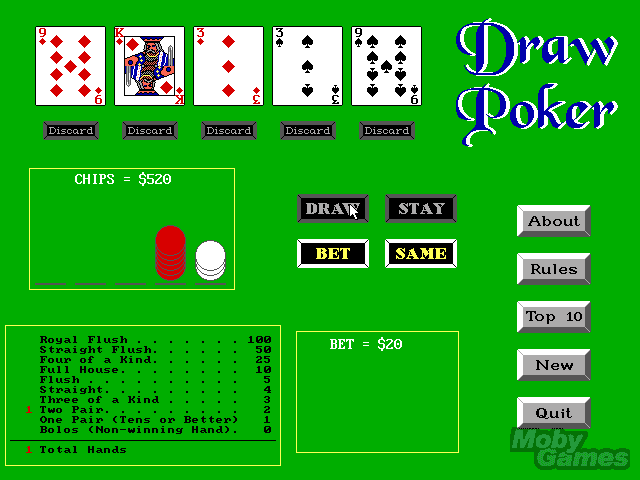
This is Five Card Draw Poker using ace-to-six ranking, in which straights and flushes count but aces can be low. Normally A-A should be the lowest (and therefore best) pair, but A-K-Q-J-10 would count as a straight - but opinions may differ, so these details should be agreed in advance among the players.
This game is often ignored or said to be unusual in books and on poker web sites. This may be because it is not played in public card rooms on the American West Coast and rarely offered as an online game. However, I suspect it is fairly widespread in home poker games, particularly on the American East Coast and in Europe.
Triple Draw
In this game players have three opportunities to improve their hand. According to some sources the maximum number of players for this game is six. Certainly with a larger number of players the cards will frequently run out and discards will need to be recycled.
Normally it is played with blinds: the player to dealer's left posts a small blind, and the next player to the left posts a big blind, equal to the mimimum bet for the game.
The dealer deals five cards to each player and there is a round of betting beginning to the left of the big blind. As usual in games with blinds, the big blind player is allowed to raise even if the others have all folded or called. Then in clockwise order, starting to dealer's left, players may discard any number of cards and are dealt replacements. There is a second round of betting begun by the first active player to dealer's left. This is followed by a second opportunity to discard and draw, a third round of betting, a third discard and draw, and a fourth round of betting. In a fixed limit game, the size of the bet is normally doubles after the second draw, so that the last two rounds have big bets.
It happens fairly often in this game that the dealer runs out of cards. In this case all the discarded cards (the 'muck') are shuffled and cut to form a new deck from which replacement cards are dealt to players who are still waiting to draw.
What Happens In A Draw In Poker
There are two versions of this game, depending on the hand ranking used in the showdown (see low poker hand ranking):
- Deuce to Seven Triple Draw, which uses deuce-to-seven ranking, is perhaps the more popular game.
- Ace to Five Triple Draw, using ace to five ranking is also sometimes played.
The Triple Draw page of the Play Lowball Poker site has further information on the history and variants of this game.
What Is A Straight Draw In Poker
Double Draw
This game is similar to Triple Draw, except that players only have two opportunities to improve their hands by drawing cards. There are therefore three betting rounds: after the deal, after the first draw and after the second draw. Either ace-to-five or deuce-to-seven (or even ace-to-six) ranking can be used, as agreed by the players.